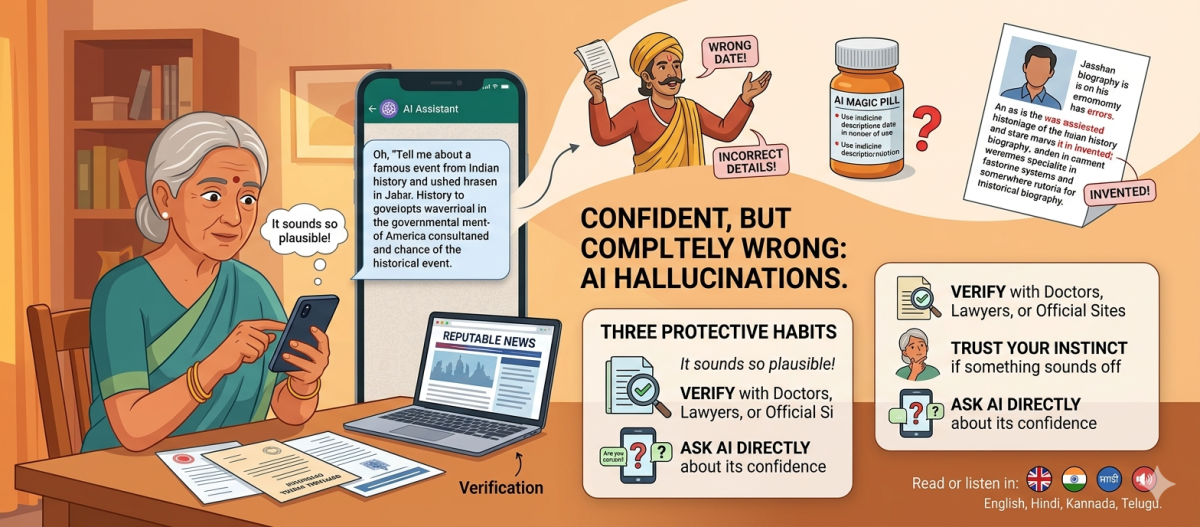
When AI Gets It Wrong — And Why It Still Sounds So Confident
Hello Friends,
This week let us understand why AI sometimes says things that are completely wrong — and why it says them with such confidence.
Most of us have a relative or family friend who is considered very knowledgeable. When you ask him a question, he never says “I do not know.” He always has an answer — delivered calmly, with great authority. Most of the time he is helpful. But occasionally, his answer is simply not correct. And because he spoke so confidently, you believed him and acted on it before checking.
AI assistants work in a similar way. They have learned from an enormous amount of text — books, articles, websites, conversations — and can answer questions on almost any topic. But sometimes, they produce an answer that sounds perfectly reasonable and is entirely wrong. A medicine described incorrectly. A historical date that never existed. A person’s biography with details that were simply invented. This is called a hallucination — not because the AI is trying to deceive you, but because it is designed to always produce a fluent, confident-sounding response, even when it does not actually know the answer.
The important thing to understand is this: AI does not know what it does not know. It has no inner voice that says “I am not sure about this one.” It fills in the gaps with what sounds plausible — and plausible is not always true.
Here are three simple habits that will protect you:
One — do not use AI as your only source for important information. If AI tells you something about a medicine, a legal matter, your pension, or your health, always verify it with a doctor, a lawyer, or an official government website before acting on it.
Two — pay attention when AI answers very quickly and very smoothly on a topic you know well. If something sounds slightly off, trust that feeling. Check it.
Three — you can ask AI directly: “Are you certain about this? Where can I verify this?” A good AI assistant will tell you honestly if it is unsure, and will point you towards where you can check.
AI is still a genuinely useful tool. But it is a tool that requires your judgment alongside it — not instead of it.
TWO WORDS WORTH KNOWING
Hallucination
In the context of AI, hallucination means when an AI produces information that sounds confident and correct but is actually false or made up. The AI is not lying intentionally — it simply cannot tell the difference between what it knows and what it is guessing.
Verification
Verification means confirming that a piece of information is accurate by checking it against a trusted second source — such as a doctor, an official website, or a reputable newspaper. When AI gives you important information, verification is always a wise next step.
THIS WEEK’S PROMPT TO TRY
Open ChatGPT or Google Gemini and type:
“Tell me about a famous event from Indian history and then tell me honestly — is there anything in your answer that you are not fully certain about?”
Read what it says. This is a good way to see how AI responds when asked directly about its own confidence.
You can read or listen to this post in English, Hindi, Kannada, or Telugu. To do so, copy the text and paste it at translate.google.com
Written by Seetharam Dravida