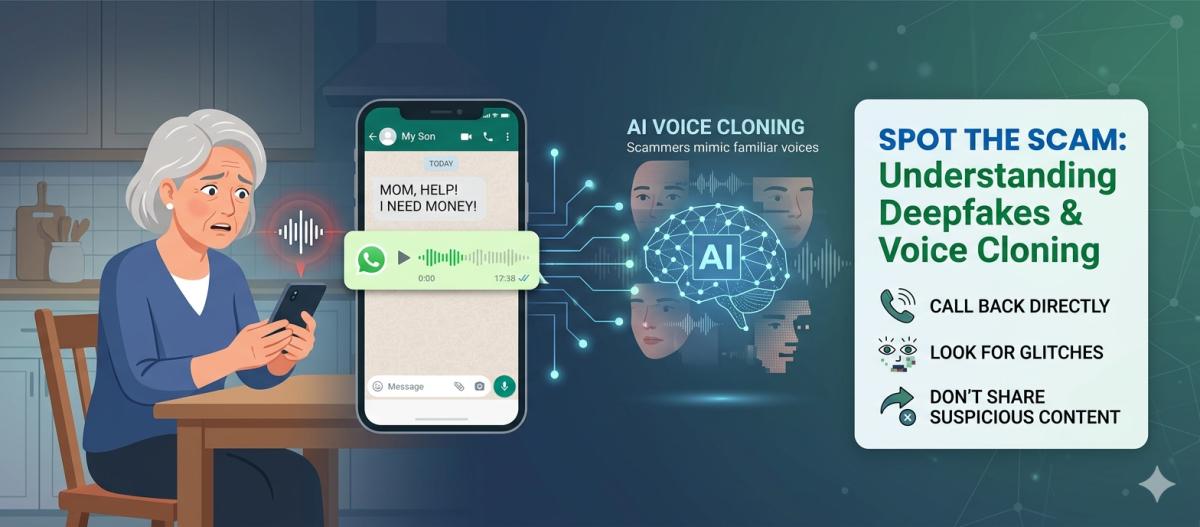
Hello Friends, this week, let us understand deepfakes.
Imagine you receive a voice message on WhatsApp. It sounds exactly like your son. He says he is in trouble and needs you to transfer money urgently. His voice, his tone, his way of speaking — everything feels real. But it is not him. It is an AI that has learned to copy his voice.
This is called a deepfake. A deepfake is a photo, video, or voice recording made by AI that looks or sounds like a real person — but is completely fake. The AI studies recordings of someone and then creates new content that mimics them so convincingly that it is very hard to tell the difference.
You may have already seen deepfakes without realising it — a politician saying something he never said, or a film actor promoting a medicine he never endorsed. These are becoming more common and are being used to deceive ordinary people.
Here are three things to remember. First, if you receive an urgent message asking for money, always call that person directly on their regular number before you do anything. Second, deepfake videos often show small errors — a face slightly blurred at the edges, eyes that do not blink naturally, or lip movements that do not match the words. Third, do not forward anything that feels wrong. A deepfake spreads only when people share it.
Two Definitions:
Deepfake: A photo, video, or voice recording created by AI that looks or sounds like a real person but is entirely fabricated. The word combines deep learning — the AI technique used — with the word fake.
Voice Cloning: A type of deepfake where AI studies a person’s voice from recordings and generates new audio that sounds exactly like them saying things they never actually said.
Today’s simple prompt for you to try is this: Open ChatGPT or Google Gemini and type — “Give me five warning signs that a WhatsApp video or voice message might be a deepfake.” Read the tips and share them with one family member. It could protect someone you love.
You can read or listen to this blog in English, Hindi, Kannada, or Telugu.
To read or listen to this blog in your preferred language, use Google Translate by copying the text and pasting it at translate.google.com
Written by Seetharam Dravida